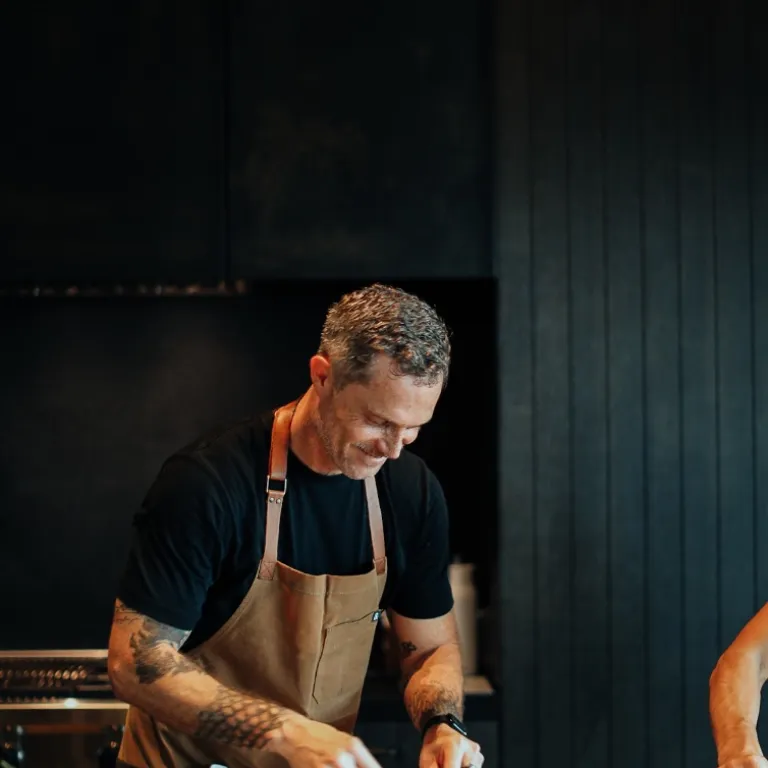
Rio, you grew up on a sprout farm in Kohala and later trained at the New England Culinary Institute before working in places from St. Thomas to San Francisco. How did these very different experiences shape your personal definition of what “excellence” means in luxury private dining in Hawaiʻi today?
I grew up on a sprout farm in Kohala, and that's still with me every day — I grow my own microgreens now and work them into my menus. But more than any single ingredient, that upbringing gave me an instinct: an understanding of exactly where food comes from, and why that matters.
New England Culinary Institute gave me the other half of that foundation — the traditional skills and techniques that everything else gets built on. Without that discipline, instinct doesn't go very far.
Then came the contrast — St. Thomas, San Francisco, and everywhere in between. Working in such different places taught me to cook from a sense of place: to really see the food, the surroundings, the culture around me, and let that work its way into the dish, rather than imposing the same menu no matter where I am.
So when I think about what excellence means in luxury private dining here in Hawaiʻi today, it comes back to sourcing. It's not plating tricks or spectacle — it's knowing your ingredients, respecting where they come from, and letting that integrity be what the guest actually tastes.
When you design a high-end private dinner on the Kona or Kohala Coast, what are the concrete elements that transform it from a ‘nice meal’ into a truly luxurious, unforgettable experience—beyond just premium ingredients and beautiful plating?
Beyond the ingredients and the plating, what actually makes a dinner unforgettable comes down to two things: intimacy and relationship.
Intimacy means the guest knows this is happening only for them, in this place, tonight — that it can't be replicated anywhere else. That's part of why I bring in things like my own duck eggs or microgreens I grow myself. It's less about the ingredient itself and more about the guest sensing something singular.
And relationship means actually getting to know the client — their likes, their dislikes, the small details most people wouldn't think to ask about. That's what turns a beautifully executed menu into a truly tailored experience, one designed around them specifically rather than served to them
You work almost exclusively with locally sourced Hawaiian products and a strong farm‑to‑table philosophy. In a luxury context, how do you balance guest expectations for indulgence with constraints like seasonality, sustainable fishing, and supporting small local producers?
In a luxury context, I actually flip the script on scarcity — instead of apologizing for what's not available, I present it as the luxury itself. Telling a guest 'this is only available right now' turns a limitation into something exclusive.
That reframe comes through in specific substitutions too. If a guest requests something like halibut or a mainland potato, I'll bring in a comparable or superior local, seasonal ingredient instead — Hapuʻupuʻu sea bass in place of halibut, or taro in place of potato. It's not a compromise; it's often the better dish.
And that philosophy starts further back than the plate — I source vegetables directly from Kekela Farm, so in a lot of ways I'm cooking around what they have that week rather than dictating the menu first and sourcing to match. That relationship is really what makes farm-to-table more than a phrase for me.
Having run Sushi Rock and then cooked in some of the most prestigious homes along the Kohala Gold Coast, can you share a specific event where everything clicked and you thought, ‘this is the pinnacle of private luxury cuisine in Hawaiʻi’? What made that moment so special, both technically and emotionally?
There's one dinner that still stands out — a five-course wine pairing for a repeat client at Rosewood Kona Village. One dish in particular was the moment: koji-marinated Kona kampachi with an ikura butter sauce and pickled chayote — and the chayote came straight from my own garden.
Technically, everything hit. The koji cure, the richness of the ikura butter, the acid from the pickled chayote — every element was doing exactly what it needed to do, and the balance was right.
But it was what the client said afterward that made it the pinnacle for me. They told me it was the best fish dish they'd had in as long as they could remember. That's when the technical and the emotional came together — because that dish only worked because the chayote was from my own garden, from home. For a repeat client, that's not just a well-executed course. It's personal, and they felt it.
The Big Island attracts very discerning clients, often well‑traveled and used to Michelin‑level experiences. What are the most demanding aspects of catering to this clientele in an intimate home setting, and how do you and your team consistently deliver—or exceed—those expectations?
The hardest part of a home setting is that you don't have a professional kitchen — you're working in someone's private space, often with equipment you didn't choose and layouts you've never seen before service starts. There's no kitchen door separating you from the guest either; every part of the process is closer to them than in a restaurant.
I had one client whose oven wasn't working the day of the dinner. I used their grill as an oven instead and roasted the tenderloin on it — it came out great, and the guest never knew anything had gone differently than planned.
What a discerning, well-traveled clientele demands is real breadth — knowledge of global techniques and cuisines, not just one specialty. These are guests who've eaten at Michelin-level restaurants around the world, so they can tell the difference between someone executing a technique correctly and someone who's just heard of it.
The way I stay consistent despite all of that is simple: I test dishes and recipes constantly at home before they ever reach a client's table. By the time a dish is served in someone's private kitchen, it's already been refined — so an unfamiliar setting or a broken oven doesn't compromise the result."
Looking ahead, how do you see luxury private dining in Hawaiʻi evolving over the next five to ten years—in terms of ingredients, guest expectations, sustainability, and the line between restaurant‑style service and immersive, at‑home culinary experiences?
Over the next five to ten years, I think all of this builds on itself. Ingredients keep moving further in the direction I already work in — more hyperlocal, backyard-grown, but also more foraging, going deeper into what the land and coastline naturally offer rather than relying only on cultivated sourcing.
That shift feeds directly into what guests want. As sourcing gets more personal, so does the experience itself — guests move away from wanting to be impressed and toward wanting to feel something: genuinely connected to the place, the chef, the story behind the meal.
Sustainability is really what makes that connection possible, and I think it stops being a selling point and just becomes the baseline. Right now I can frame seasonal, sustainable choices as a luxury; in five to ten years, guests will simply expect it — it won't need to be sold as special anymore, because anything less won't be acceptable.
And that same shift plays out in format too. I don't think immersive at-home dining replaces restaurants — I see it staying a niche alongside them, especially for larger groups where an in-home private experience makes more sense than fitting a big party into a restaurant setting. The two will coexist, just serving different needs.
For someone dreaming of hiring a private chef experience on the Big Island, what personal advice would you give them to truly savor the excellence of luxury Hawaiian cuisine—whether it’s how to choose their chef, shape the menu, or simply be present at the table?
If you're dreaming of a private chef experience here, my advice starts with how you choose: look for real experience, specifically here on the Big Island, and get referrals from other clients. Local experience matters — cooking well is one thing, but understanding this place, its ingredients, and its culture is another.
Once you've chosen your chef, my advice is to let go a little. Tell me your allergies and your dislikes, and then let me create from there. The best dinners I've done happen when guests give up some control — that's counterintuitive, I know, but it's when a chef can actually do their best work, rather than executing someone else's idea of what the meal should be.
And at the table, be present. Ask questions about the dishes — where the fish came from, why a certain ingredient is on the plate. Every dish has a story, and asking about it is really the best way to savor it, not just eat it.
Learn more: https://riochef.com