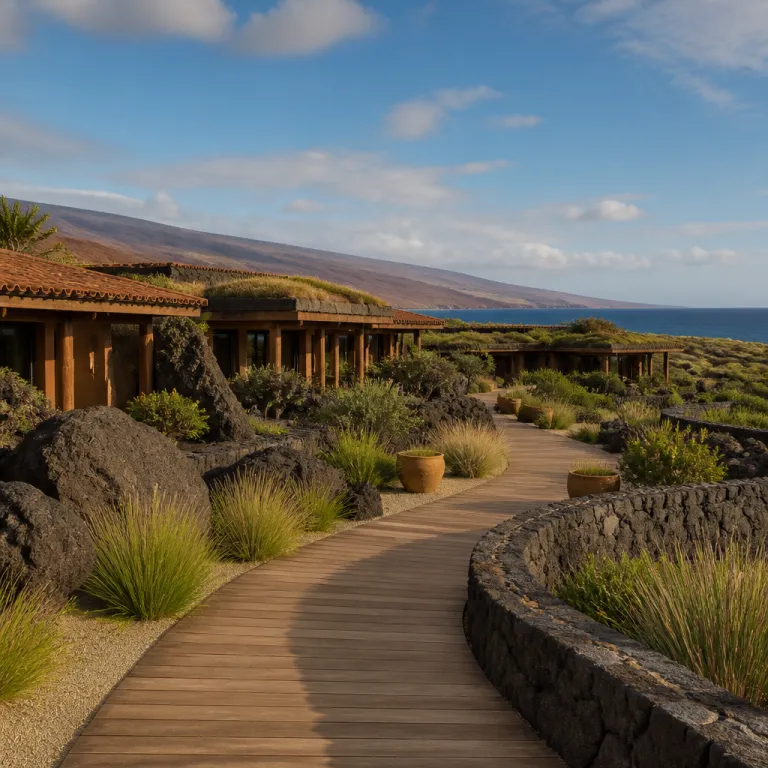
Big island resort architecture and the Hawaiian design philosophy
On the Big Island, luxury hotels and resorts are designed to recede, not shout. This Big Island resort architecture and Hawaiian design philosophy treats every property as a guest on ancient land, where lava flows, trade winds, and fishponds set the rules. The best resort teams understand that architecture must feel almost invisible, allowing the island itself to carry the experience.
Unlike in Waikiki or Wailea, where towers frame the beach, island Hawaiʻi places volcanic geology at the center of every design decision. Architects work with raw lava fields, black rock headlands, and sheltered coves along the Kona Coast, shaping each guest hale and public space around what the land will allow. This is why Big Island resort design often feels lower, more horizontal, and more elemental than on other islands.
From the earliest original property experiments in the 1960s to today’s award‑winning hotels and resorts, the through line is respect. Natural materials such as local stone, hardwoods, and woven palms are used to echo traditional Hawaiian hale while meeting contemporary comfort standards. As one design reference from the Hawaiʻi Tourism Authority puts it with clarity, “Natural materials like wood, stone, and woven palms are commonly used.”
Mauna Kea and the open air legacy of Rockefeller and SOM
Mauna Kea Beach Hotel, opened in 1965, remains the clearest manifesto of Big Island resort architecture and Hawaiian design at scale. Commissioned by conservation‑minded philanthropist Laurance Rockefeller and designed by Skidmore, Owings & Merrill (SOM), the property pioneered open‑air lobbies, framed ocean sightlines, and a complete rejection of enclosed corridors. You move through breezeways and terraces rather than hallways, with the Pacific acting as the central atrium.
This original property has been carefully renovated, most notably after the 2006 Kīholo Bay earthquake, so that its mid‑century architecture still feels crisp, while solar arrays now supply a significant share of the resort’s energy. The Rockefeller Art Collection—often described in hotel materials as numbering more than 1,600 works at its peak and now represented by hundreds of restored pieces from Asia, the Pacific, and the West—turns the hotel into a living gallery where sculpture niches and wall planes were conceived as part of the interior design. For travelers comparing suites and luxury vacation rentals, Mauna Kea offers a benchmark for island elegance in a resort setting.
What sets Mauna Kea apart from many hotels and resorts on other coasts is how its architecture edits your view. Every public place is oriented to the bay, with lanais and restaurants stepping down toward the sand rather than stacking vertically. The result is a resort that feels almost like a terraced village, where each level of the design quietly serves the landscape instead of dominating it.
Kona Village by Rosewood and the power of the standalone hale
On the lava crust of the Kona Coast, Kona Village, A Rosewood Resort, shows how a property can feel like an ancient settlement reborn. The original Kona Village Resort, opened in 1965 and closed after the 2011 tsunami, was long beloved for its thatched hale scattered across the shore, and the new Rosewood resort keeps that spirit while elevating every detail. Instead of a single hotel block, you get a loose village of standalone guest hale, each one a private pavilion with no shared walls.
Walker Warner Architects, led by Greg Warner, worked with the existing lava fields and fishponds rather than erasing them, so paths curve around outcrops and palms instead of cutting straight lines. The architecture sits low, with steeply pitched roofs and deep overhangs that recall traditional Hawaiian hale while hiding sophisticated engineering for shade and cross‑ventilation. Inside, NICOLEHOLLIS handles the interior design, blurring boundaries between indoor lounges and outdoor lanais with sliding walls, stone floors, and natural materials that age gracefully in the salt air.
For guests, this Big Island resort architecture approach changes how you inhabit the property. You walk through a Rosewood village landscape of lava, palms, and water, not through air‑conditioned corridors, and every guest hale feels like a small house embedded in the land. As principal Greg Warner has noted in interviews, the goal is for the village to feel “as if it grew from the lava itself,” and if you are weighing high‑end hotel suites against curated luxury hotel packages on the Big Island, Kona Village offers one of the most private yet grounded experiences on island Hawaiʻi.
Island decor, materials, landscape, and sustainability
Thoughtful Big Island resort architecture always begins with the ground, especially where lava flows meet the sea. On the Kona Coast, you see hotels and resorts stepping lightly across black rock terraces, using boardwalks, raised platforms, and low stone walls to protect both guests and fragile tide pools. The aim is not to tame the lava but to choreograph how you move through it, with each path and terrace revealing a new angle on the ocean or the mountains.
Inside the guest hale and suites, island decor leans toward texture rather than ornament, with rough stone, woven fibers, and warm woods echoing the surrounding land. Designers such as NICOLEHOLLIS often use a restrained palette so that the color comes from the sky, the water, and the greenery outside, not from the furniture. This restraint is one reason properties like Kona Village and Mauna Kea appear regularly in Architectural Digest and on design awards shortlists, where juries look for architecture that feels both original and rooted.
Other properties along the Kohala and Kona Hawaiʻi coasts, including Fairmont Orchid near Waimea, follow similar principles with their own variations. HBA San Francisco shaped that resort’s public spaces to tell a geological story, using stone, water features, and open‑air volumes to echo the island’s volcanic narrative. Mauna Lani integrates ancient fishponds into its landscape plan, treating them as living cultural features rather than decorative lagoons, while solar installations and native planting reduce energy and water use. If you want to go deeper into the geology that shapes these decisions, a field trip to the island’s lava tubes and subterranean landscapes will give you a visceral sense of how architecture must adapt to the rock.
From fishponds to solar panels: sustainability as a design language
On the Big Island, sustainability is not a marketing add‑on; it is the organizing principle of serious resort architecture. Mauna Lani’s restored fishponds, some dating back centuries, are integrated into daily operations, and paths are aligned so guests understand this relationship between water, land, and food. At Mauna Kea, solar infrastructure and natural ventilation strategies update the original architecture without compromising its open‑air elegance; public statements from the resort note that photovoltaic systems now offset a meaningful portion of the property’s electrical load.
Across island Hawaiʻi, new hotels and resorts work with environmental consultants and cultural advisors to ensure that each property respects both ecology and tradition. Design teams use native landscaping to reduce irrigation, orient buildings for cross‑ventilation, and specify materials that can withstand salt, wind, and sun without constant replacement. As one sustainability‑focused Q&A notes, “How do these hotels integrate with the landscape? By using organic architectural forms and native landscaping.”
For travelers, this means that choosing a resort is also a choice about how you want to relate to the island. A guest hale set back from the shore might offer better breezes and less impact on coastal ecosystems than a room directly on the sand, even if both share the same Kona Hawaiʻi address. When you evaluate Big Island resort architecture and Hawaiian design, look for properties that treat sustainability as architecture, not as a separate checklist, because those are the places that will still feel timeless on your next visit.
Kona village, Rosewood, and the new generation of design led resorts
The rebirth of Kona Village as a Rosewood resort marks a turning point for high‑end hospitality on the Big Island. Where some older properties expanded vertically, this Rosewood village project doubles down on the low‑slung, landscape‑first approach that made the original Kona Village so beloved. The 81‑acre site is treated as a series of micro‑neighborhoods, each cluster of hale responding to subtle shifts in wind, views, and lava formations.
Walker Warner and Greg Warner have been explicit that the architecture should feel like it has always been there, even though the construction is entirely new. Kennedy Wilson, as owner and developer, backed this long view, prioritizing a design process that engaged cultural practitioners and environmental experts rather than chasing quick density. The result is a property where awards and Architectural Digest features feel like byproducts of integrity, not the primary goal.
Inside, NICOLEHOLLIS uses interior design to extend the same ethos, with custom furnishings that reference traditional Hawaiian forms without slipping into pastiche. You will notice how the line between guest hale and landscape is softened by outdoor showers, lava rock walls, and planting that creeps right up to the lanai. For travelers who care about Big Island resort architecture and Hawaiian design, this is one of the clearest examples of a resort designed to disappear into its own village‑scale world.
How to read a Big Island resort before you book
When you scan photos of a Big Island property, start by looking at how the buildings sit on the land. Do you see low, horizontal forms stepping with the terrain, or tall blocks that ignore the contours of the lava fields and shoreline? Resorts that follow the best Big Island resort architecture principles will usually show generous roof overhangs, open‑air walkways, and plenty of unbuilt space between structures.
Next, pay attention to the guest hale or room layouts, especially on the Kona Coast and around Kailua‑Kona. Standalone units or small clusters often signal a village‑like approach, where privacy and outdoor living matter as much as square footage. If the resort highlights its use of natural materials, native landscaping, and cultural programming, you are likely looking at a property that understands Hawaiian architecture as more than a style.
Finally, read how the resort talks about its history and design team, including any mention of firms such as Walker Warner, NICOLEHOLLIS, or HBA San Francisco. References to design awards, features in Architectural Digest, or collaborations with cultural advisors can help you separate marketing language from genuine architectural intent. For travelers who value both comfort and context, these clues will guide you toward places where the architecture serves the landscape, not the other way around.
FAQ
What materials are most common in Big Island resort design?
High‑end resorts on the Big Island rely heavily on natural materials that can withstand the marine climate. Stone, hardwoods, and woven palm or grass elements are used to echo traditional Hawaiian hale while meeting modern safety standards. As one design reference from the Hawaiʻi Tourism Authority states, “Natural materials like wood, stone, and woven palms are commonly used.”
How do Big Island hotels integrate with the volcanic landscape?
Resorts are typically arranged to follow the contours of lava flows and existing topography rather than flattening the site. Architects use organic forms, low profiles, and native landscaping so that paths, pools, and guest hale feel embedded in the land. This approach allows the lava fields and coastline to remain the dominant visual elements.
Are Big Island luxury resorts environmentally friendly?
Many leading properties on island Hawaiʻi incorporate sustainability from the earliest design stages. You will see natural ventilation instead of full mechanical cooling in some public spaces, solar installations, and extensive use of native plants to reduce water use. A design Q&A summarizes this by noting, “Yes, they employ sustainable practices and materials.”
Do Big Island resorts offer authentic cultural experiences on site?
Most top‑tier hotels and resorts now work closely with cultural practitioners to offer programs that go beyond entertainment. Guests can often join hula workshops, outrigger canoe outings, or talks on local history and land stewardship. As one reference explains, “Yes, many provide activities that showcase local traditions.”
Why does Big Island resort architecture feel different from Waikiki or Wailea?
The Big Island’s scale and geology encourage a more horizontal, landscape‑driven architecture. Instead of dense beachfront towers, you find villages of hale, open‑air lobbies, and buildings that step with the lava terraces. This creates a quieter, more elemental experience where the island, not the structure, is the main event.